
Kotohira is usually known for its long stairway to Kompira-san. But living here for a few months taught me something else: the town has a surprisingly rich cultural scene. Between remote-work sessions, cafe stops, and evening walks on Omotesandō, I found myself slipping into small museums. They reveal a deeper side of the place. It’s this mix of art, maritime roots, craftsmen and stories behind the famous shrine that inspired me to create this Kotohira Culture Guide.
Most museums here are compact and easy to explore, which makes them perfect for a slow afternoon. A gentle break from your screen. Some are housed in traditional buildings; others feel like stepping into a private collection. And throughout the year, you’ll also find short pop-up exhibitions in different locations around town, adding a spontaneous creative touch to everyday life in Kotohira.
Here is a Kotohira Culture Guide : a look at the best museums and exhibitions to explore.
Table of Contents
- The Gallery of Kotohiragu Treasures
- Kinryo Sake Museum
- Museum of Maritime Science
- Kyuman Museum
- Takahashi Yuichi Museum
- Omote Shoin
- Pop-up Exhibitions in Kotohira
- Wrapping Up Your Kotohira Culture Guide
- FAQ – Kotohira Culture Guide
The Gallery of Kotohiragu Treasures
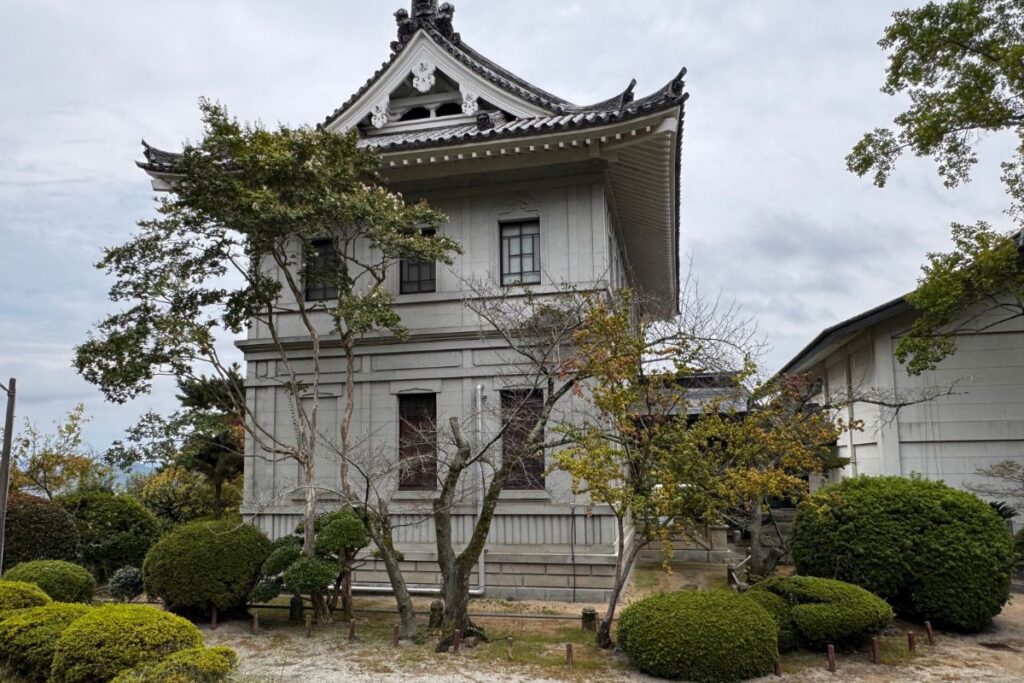
Hidden inside the upper grounds of Kompira-san, the Gallery of Kotohiragu Treasures is one of the most atmospheric places to explore during a cultural visit in Kotohira. I stepped inside right after climbing the long stairway and it felt like entering another world. The building has been standing here for more than a century. It was actually completed in 1905 and built using granite from Kagawa Prefecture. It’s a mix between Japanese and Western influences in its design, which gives a unique charm.
History and Architecture
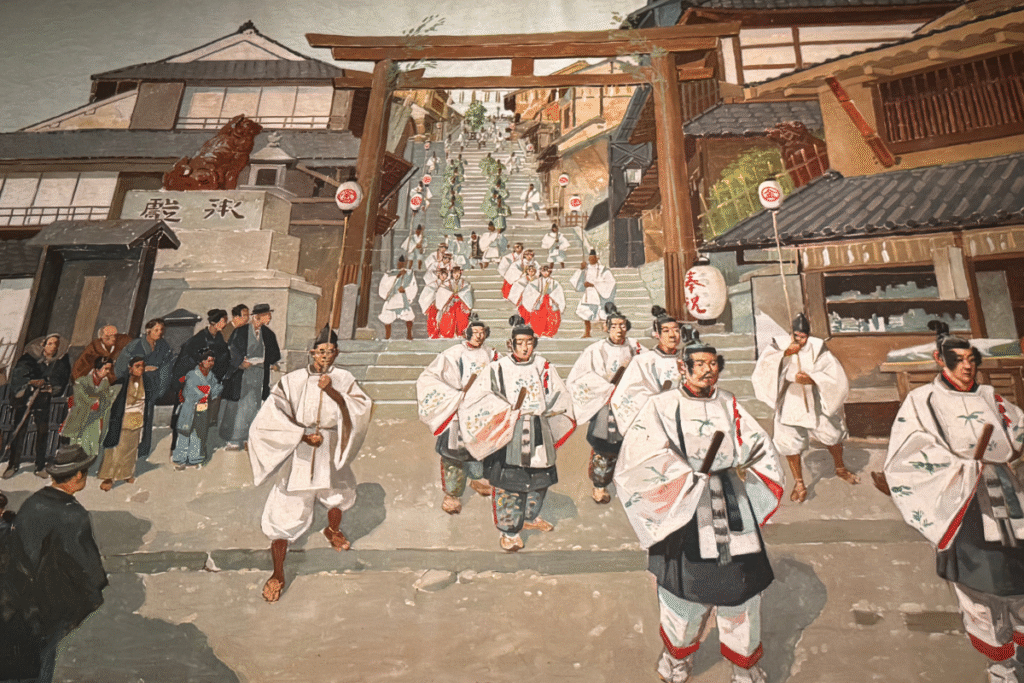
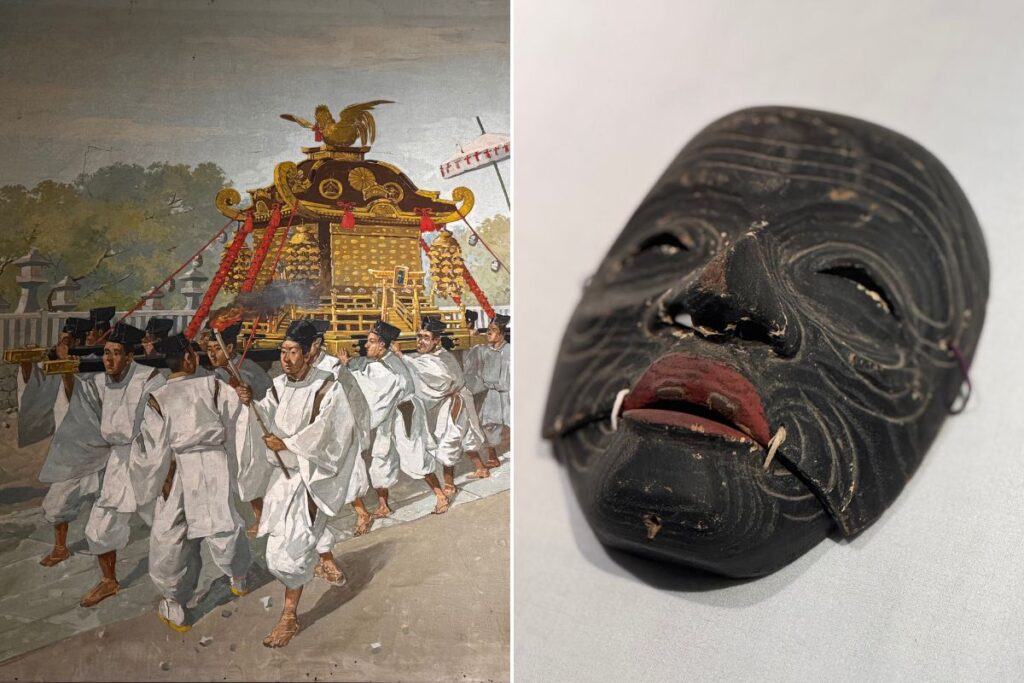
The museum is arranged across two floors. Here you can see showcases filled with sacred objects, lacquerware, armor, ceremonial tools and manuscripts. This is also where you will find a beautiful historic drawing of Kotohira. It shows Omotesandō as it looked in earlier centuries, with long wooden façades, merchants, pilgrims and the lively atmosphere that once surrounded the approach to the shrine. Nearby, a series of paintings illustrates the Grand Shrine Festival as it used to be. These scenes are vibrant and detailed, and they help you imagine how central the shrine was in the daily life of the town.
Highlights of the Collection
Upstairs, the second floor continues the journey. You can see more religious objects, artworks and preserved items that build a complete picture of the shrine’s role through the centuries. One of the highlights of the collection is a wooden statue of the Eleven-faced Kannon from the Heian period. It is classified as an Important Cultural Property and is carved from a single block of wood. Another major piece is a festival procession screen dating back to around 1702. It is also considered an Important Tangible Folk Cultural Property and gives a vivid view of the shrine’s ceremonial life at the time.
Most explanations are written in Japanese, but you can use your smartphone with Google Translate to read the descriptions and understand the stories behind each piece.
Practical informations:
Opening hours: 9am to 5pm (last entry at 4.30pm)
Closed: Tuesdays (if Tuesday is a holiday, it opens and the next day closes instead)
Entrance fee: 800 yen
There are discounts available if you visit other museums such as the Marine Science Museum, and there is also a three-museum combined ticket that includes this gallery, Omote Shoin and the Takahashi Yuichi Museum.
Good for: a quiet cultural pause during your Kompira-san visit, anyone interested in shrine history and travelers who enjoy slow, meaningful museum experiences.
Kotohira Culture Guide : Kinryo Sake Museum
Just a short walk from the beginning of Omotesandō, almost in front of Kotori coworking & hostel, you will notice a long white-walled brewery building with dark timber details and a traditional sugidama hanging outside. This is the Kinryo Sake Museum. It once belonged to an active sake brewery, and stepping inside feels like crossing into a quieter, older Kotohira. The light drops, the air becomes cooler and the smell of wood and rice fermenting in the past still seems to linger in the walls.
A Look into Traditional Sake Making
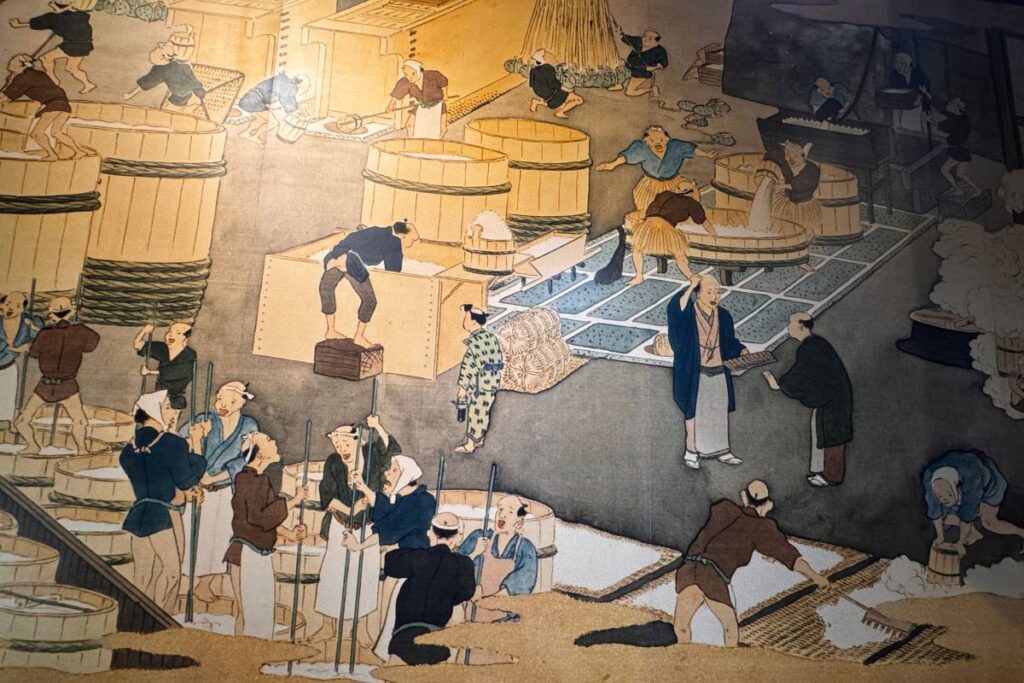
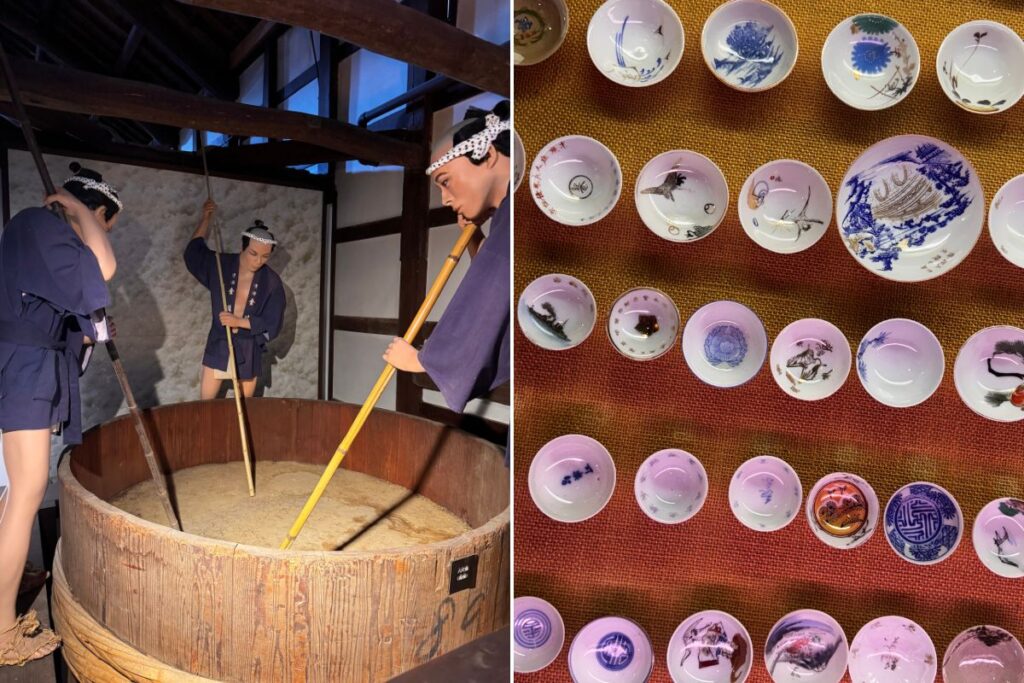
Kinryo’s history dates back to 1616, and the current museum occupies one of the former storage houses of the brewery. Inside you will find original tools used in the brewing process, including wooden vats, washing tubs, barrels and various rice preparation equipment. Simple displays explain how sake used to be made before modern machines became common. Even without reading Japanese, it is easy to follow the process thanks to the objects, photos and life-size models that recreate scenes from the old brewery.
These models help you imagine the rhythm of work that once took place here and the traditional atmosphere of sake production in Kagawa. The building itself adds to the experience, with its thick wooden beams and quiet interior that feels almost untouched by time.
Tasting Corner and Museum Grounds
After exploring the interior, you step back outside into a wide open courtyard where a large camphor tree stands at the center. Its branches cast shade over the entire space, and there are benches where you can sit for a moment and let the visit settle. This area sometimes hosts small cultural events or temporary pop-up exhibitions, which adds another layer to the museum experience.
At the end of the visit you can enjoy a small tasting of Kinryo sake in the shop. You can sample a few varieties of local sake, which is perfect for discovering the flavor of the region before deciding whether to bring a bottle home. The shop also offers small regional products and souvenirs connected to the brewery and the area.
Practical informations:
Opening hours:
Weekdays 9am to 4.30pm
Weekends and public holidays 9am to 5.30pm
(Last entry is 30 minutes before closing)
Open every day
Entrance fee: free
Good for: visitors interested in traditional crafts, travelers curious about local food and drink heritage, anyone who enjoys quiet cultural stops that feel authentic and easy to explore.
Museum of Maritime Science of Kotohira
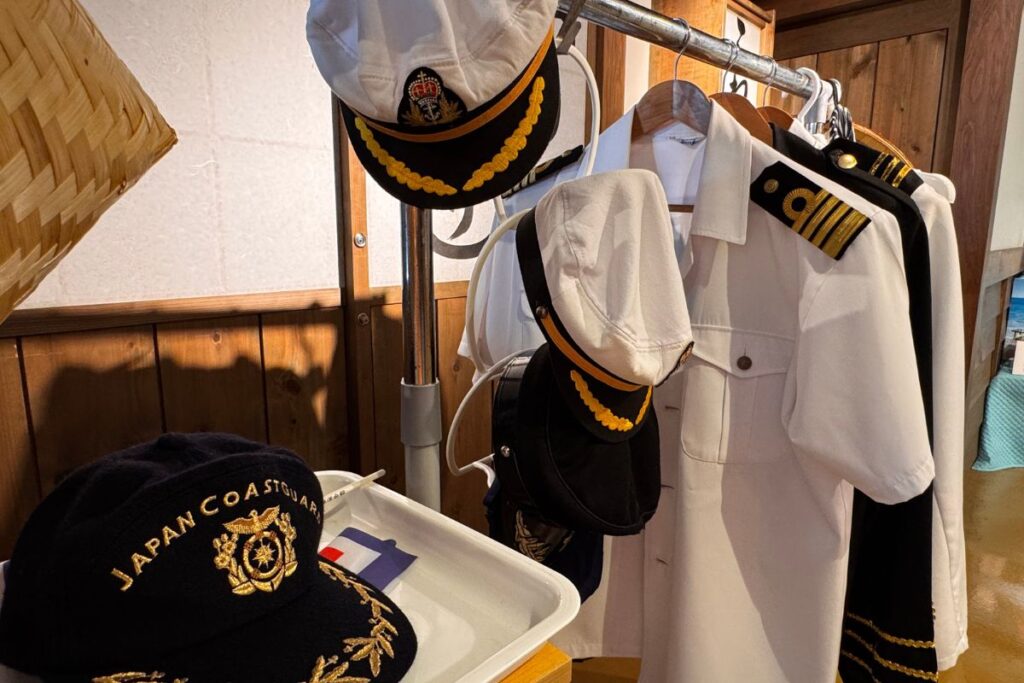
A little away from the main shrine approach and the busy streets, the Museum of Maritime Science in Kotohira feels like a quiet reminder of why this town became famous in the first place. Konpira-san is known as a protector of sailors and ships, and this museum sits near the foot of the hill, dedicated to the long relationship between people and the sea. It is not a big, shiny attraction, but more of a local place where you slowly walk through ship models, maps and stories that connect Kotohira to the ocean, even though the town itself is inland.
Exhibits and Atmosphere
Inside, the museum is organised over several floors with different sections that talk about the history of seafaring in Japan, the science of the deep sea and how ships actually work. You will see large ship models, parts of engines, panels about navigation and displays that recreate an Edo-period dock, complete with a full-size Konpira ship. It feels a bit like walking into a giant model maker’s workshop, with details to notice everywhere.
Some rooms focus on life at sea, ocean exploration and the technology that allows ships to move across long distances. Others talk about the dangers of storms and the importance of safe passage, which links nicely back to the role of Konpira as a sea guardian. Most of the written explanations are in Japanese, but in some areas there are QR codes that give access to English text, and you can also use your phone to translate signs if you want to go deeper into the context.
Interactive Corners and Viewpoints
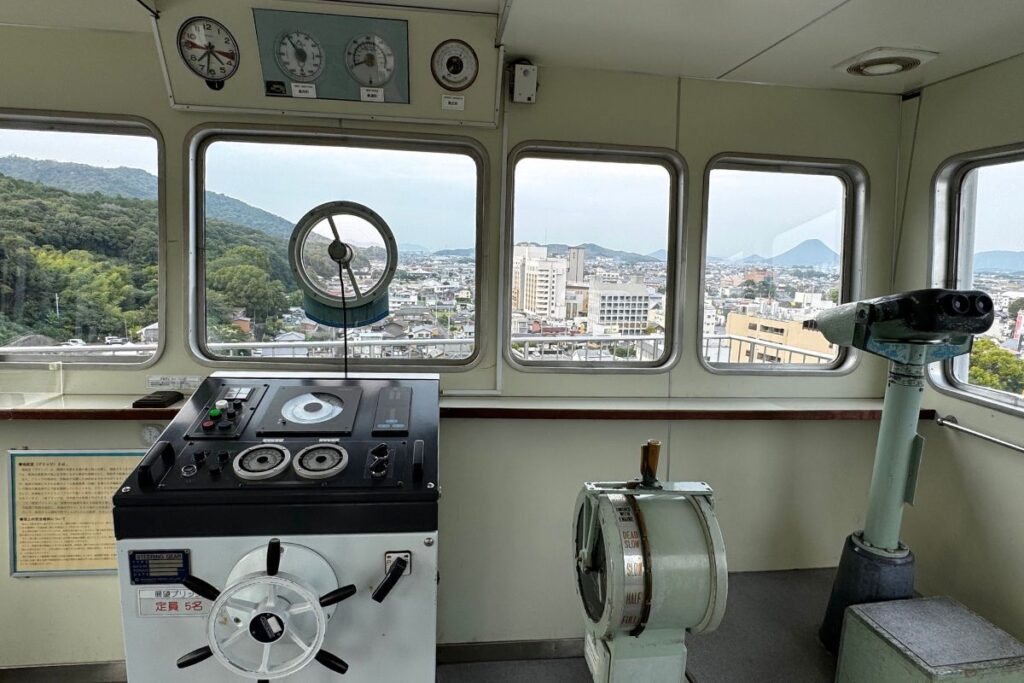
One of the charms of this museum is that it is not only about looking at objects behind glass. There are several hands-on corners where you can try radio-controlled boats, explore a piloting simulator and step into the “observation bridge”. From here you get a view over the surroundings while standing in a recreated steering room. It’s quite fun if you like the idea of “driving” a ship without actually leaving the building.
These interactive areas make the museum a really fun way to take a break from your laptop. Play with ship models, explore the different rooms and let your brain switch into “curious kid” mode for an hour.
Practical informations:
Opening hours:
9am to 5pm (last entry at 4:30 pm)
Open all year round
Entrance fee: 800 yen
There are also discount options if you combine your visit with other cultural spots in Kotohira, such as the Gallery of Kotohiragu Treasures.
Good for: people who like ships and the sea. Curious visitors who want to understand why a mountain shrine became so important for sailors.
Kyuman Museum of Art
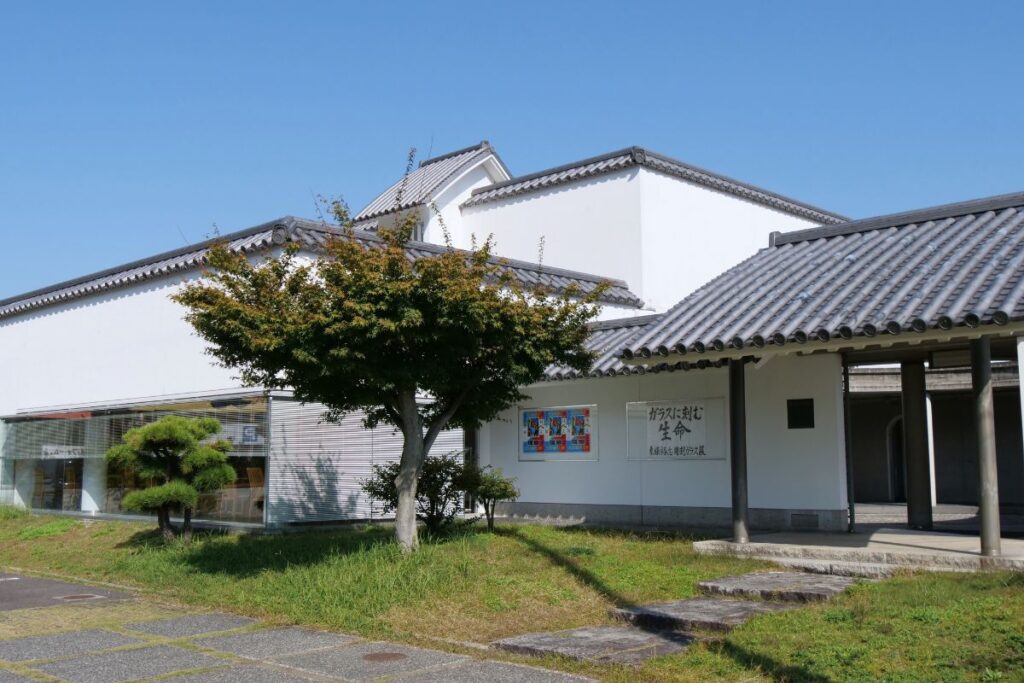
Kyuman Museum of Art is a small, peaceful museum dedicated to the work of Wada Kunibō, an artist from the region known for his expressive line work and humour. It is the kind of place where you instantly feel the pace slow down. The building is simple and bright, and it works very well as a quiet cultural stop between work sessions.
When you step in, you first arrive in a round entrance hall. From there, you can access the Kyuman Museum of Art or the Moxibustion Museum Gallery.
Inside the Museum: Wada Kunibō’s World
The Kyuman Museum of Art is dedicated to Wada Kunibō, with posters, illustrations, sketches and paintings that trace his career. Some works are playful and funny, others more graphic and bold, but they all share a clear, personal style. The atmosphere is calm, with soft lighting and enough space to walk around slowly and look at the details. Even if you do not read every label in Japanese, the visual side of the museum is strong enough to enjoy on its own.
The museum works through temporary exhibitions that focus on different aspects of Wada Kunibō’s art, so each visit offers a new way to discover his creativity.
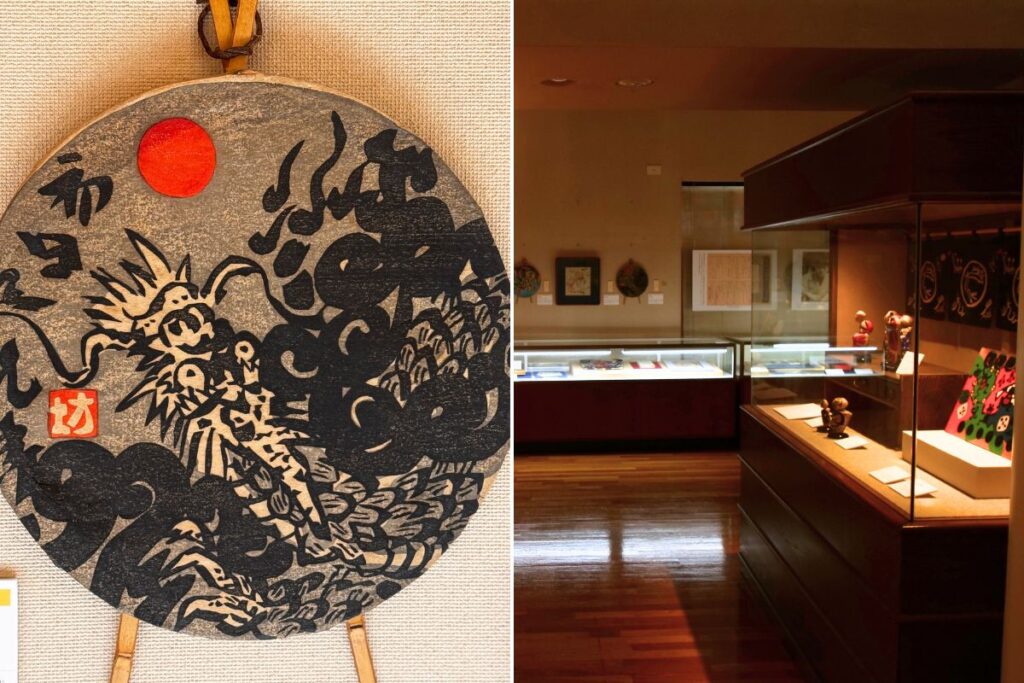
Moxibustion Gallery, part of your Kotohira Culture Guide
From the same entrance area you can also go into the Moxibustion Museum Gallery, a gallery space next door that hosts rotating exhibitions. These shows change regularly and can feature local artists, themed displays or seasonal projects. You may even have the chance to meet the artist if they are present to introduce their work. It is usually a quick visit, but it adds a nice extra layer to the museum experience.
Next to the museum cash desk, you will also find Café Konpīra, a cosy cafe that is perfect for a quiet drink or a short break after your visit.
A full visit to the museum, gallery and café can fit easily into an hour, which makes it very easy to integrate into a working day.
Practical informations:
Opening hours: 9am to 5pm
Closed: Tuesdays, Wednesdays and New Year holidays
Entrance fee: 500 yen
Good for: calm and inspiring break. Visitors who enjoy illustration and small museums. Anyone curious about local artists and creative spaces in Kotohira.
Takahashi Yuichi Museum a must in the Kotohira Culture Guide
The Takahashi Yuichi Museum is a quiet and elegant space dedicated to one of Japan’s earliest pioneers of Western-style oil painting. Visiting the museum feels like stepping into a moment of Meiji-era creativity. It is small, calm and filled with soft light, which makes it a very pleasant cultural stop on the way to the Kotohira-gu.
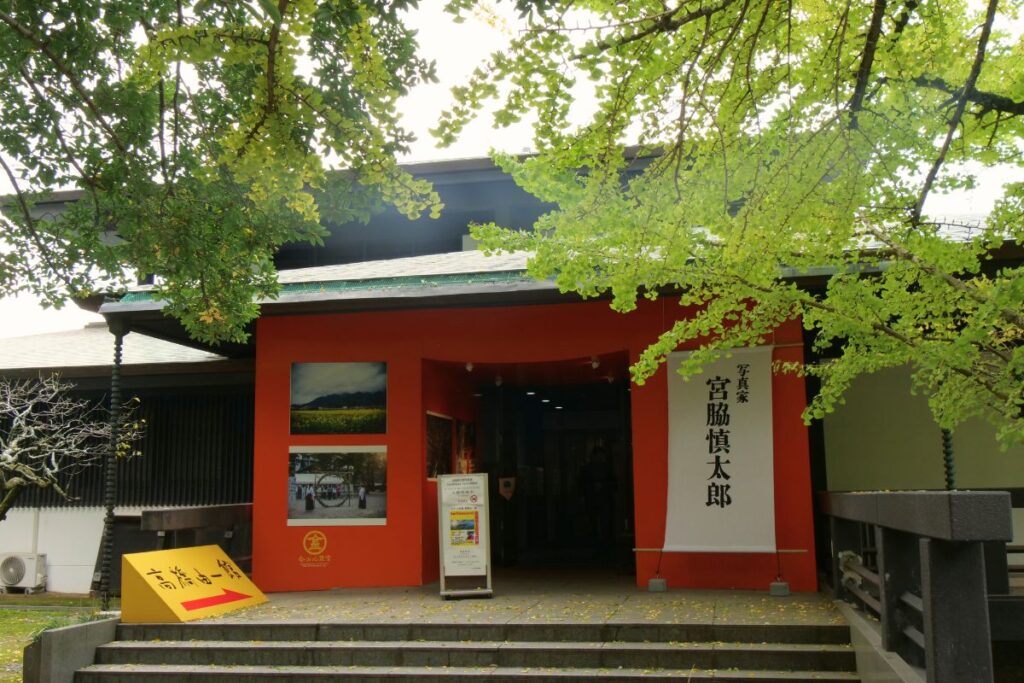
A Pioneer of Japanese Oil Painting
Takahashi Yuichi is known as a major figure in Japan’s transition to Western-influenced art during the late Edo and early Meiji period. The shrine owns twenty-seven of his oil paintings, originally acquired by the chief priest during Yuichi’s lifetime. The museum displays around twenty of these works.
Inside the museum you can see still lifes, portraits and works that show Yuichi’s dedication to realism. One of the most interesting pieces is the rediscovered portrait of Kotohira chief priest Kunizō Kotohira, a painting that was thought lost for decades until it was found again in 2001. Standing in front of these works gives you a sense of how bold and experimental Yuichi was at the time. His brushwork is direct, detailed and surprisingly modern.
Practical informations:
Opening hours: 9am to 5pm (Last entry: 4.30pm)
Closed: Tuesdays (or the following day if Tuesday is a national holiday)
Entrance fee: 500 yen.
Discounts available: Setouchi Art Museum Network coupon, Marine Science Museum discount, or three-museum common ticket.
Good for: visitors who enjoy art history, anyone curious about early Japanese oil painting.
Omote Shoin
Omote Shoin is one of the most refined historic buildings within the Kotohira Shrine complex. Built between 1658 and 1660, it once served as the official reception hall of the shrine’s head priest, who welcomed important visitors here and held formal gatherings. Today, it is preserved as a cultural site where you can quietly walk along the wooden corridor and admire the beauty inside the tatami rooms from the outside.
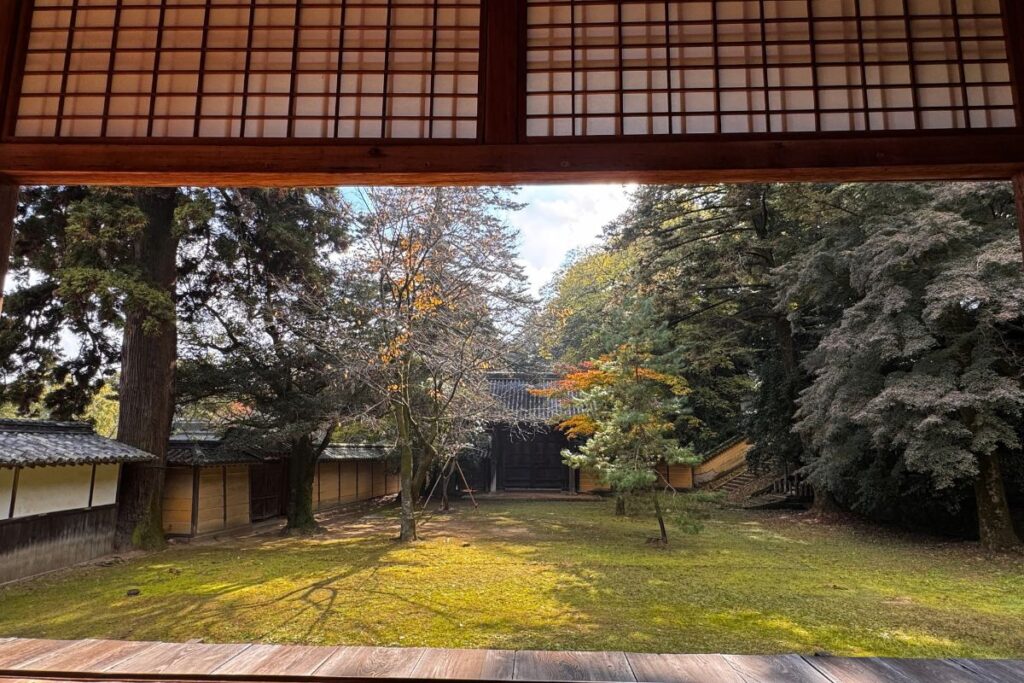
A walk between art and garden
Visitors do not enter the tatami rooms. Instead, you follow a covered wooden walkway that wraps around the building, pausing at open windows and sliding doors to look inside. This creates a calm and respectful visit, where the architecture and artworks can be appreciated without disturbing the space. From the walkway, you can observe the structure of the rooms, the soft light falling on the tatami and the incredible fusuma paintings created by Maruyama Ōkyo. Some of the most striking rooms include the Cranes Room, the Tigers Room, the Seven Sages Room and the Landscape Room.
Along the way, you can also admire the Japanese garden that stretches outside the rooms. Carefully shaped trees, stones and seasonal greenery frame the view, and the garden acts like a living backdrop to the painted screens inside. Walking the corridor feels a bit like moving through a sequence of quiet picture frames, each one opening onto a different angle of the house and its garden.
Practical informations:
Opening hours: 9am to 5pm (Last entry: 4:30pm)
Closed: Tuesdays (or the following day if Tuesday is a national holiday)
Entrance fee: 800 yen
Good for: anyone who loves traditional Japanese architecture, a quiet and meaningful stop.
Pop-up Exhibitions in Kotohira
Beyond museums and historic buildings, Kotohira also has a small but lively contemporary art scene. Throughout the year, you can come across temporary exhibitions, artist residencies and creative events hosted in different spaces around town. It is a nice way to see how local life, cafés and community projects connect with art on a very human scale.
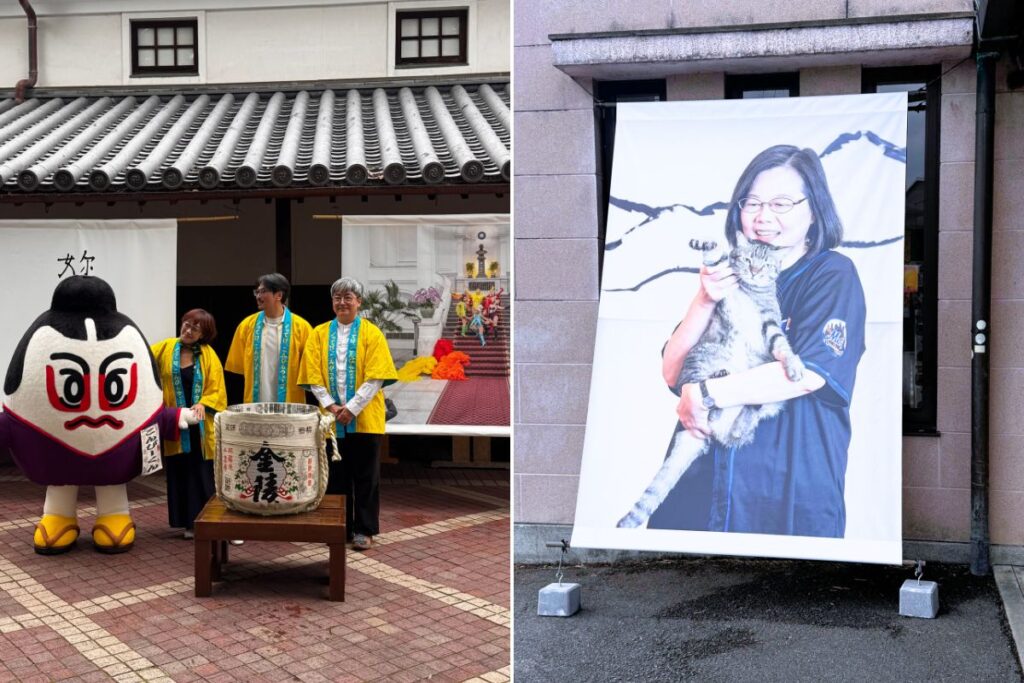
Hakobune Project, part of the Kotohira Culture Guide
Hakobune is a large multi-storey building that used to be a busy complex of souvenir shops, eateries and banquet halls. After sitting unused for many years, it is now being slowly renovated by a group of locals. Their aim is to transform it into a creative playground while keeping its original character, with gallery spaces, small studios and event areas.
The building regularly hosts exhibitions, talks and events linked to contemporary art and local culture. Some shows are the result of artist residencies such as HAKOBUNE AIR, where artists stay in Kotohira and create work in response to the town. Others are part of wider programs and festivals connected to Kotohira. The schedule changes, so it is worth checking posters in town or online announcements to see what is happening during your stay.
On the ground floor, you’ll find Sando Sand Stand, a stylish café known for its sandwiches, muffins, seasonal sweets and relaxed vibe. It is also one of the best places in Kotohira to work from for a few hours. At the back of the café, there is a small exhibition space that regularly hosts photography shows, illustrations, handmade crafts or pop-up displays from local creators.
Kotohira Art
Kotohira Art is an initiative that brings many of these cultural threads together. It is involved in projects such as the Kotohira Yama Expo, which connects venues like Hakobune, Kotori Coworking & Hostel, local temples and other sites through a shared art program. Exhibitions, events and talks are spread across the town and often highlight artists from Shikoku and beyond.
For visitors and digital nomads, Kotohira Art is a useful reference point to understand what is happening culturally at a given moment. Follow their Instagram for an overview of ongoing exhibitions and special events.
Wrapping Up Your Kotohira Culture Guide
Exploring culture in Kotohira is not only about climbing the steps to Kompira-san. The town has a calm, well-balanced mix of museums, historic buildings and small creative spaces that offer gentle pauses throughout the day. From centuries-old shrine treasures and Edo-period architecture to local art studios, sake heritage and contemporary pop-ups, each place adds a new layer to the town’s character.
For digital nomads, these spots fit naturally between work sessions, café stops and slow walks. They are compact, peaceful, easy to access and full of details that help you understand Kotohira beyond its famous shrine.
I hope this Kotohira Culture Guide helps you find gentle, meaningful cultural pauses during your stay.
FAQ – Kotohira Culture Guide
What are the best cultural places to visit in Kotohira?
The main cultural spots presented in this Kotohira Culture Guide include the Gallery of Kotohiragu Treasures, the Kinryo Sake Museum, the Museum of Maritime Science, the Takahashi Yuichi Museum, Omote Shoin, the Kyuman Museum of Art and several pop-up exhibition spaces such as Sando Sand Stand and Hakobune.
Is Kotohira good for digital nomads?
Yes. Kotohira is calm, walkable and full of peaceful cultural stops that fit easily between remote-work sessions. You can switch between coworking spaces, cafes and small museums without rushing.
Which museum should I visit first?
If you are visiting Kompira-san, start with the Gallery of Kotohiragu Treasures near the upper grounds. It’s a good introduction to Kotohira history.
How much do the museums cost?
Most museums range between 500 and 800 yen. Some, like the Kinryo Sake Museum, are free. There is also a three-museum common ticket that includes the Gallery of Treasures, Omote Shoin and the Takahashi Yuichi Museum.
Are the museums in Kotohira beginner-friendly for people who do not speak Japanese?
Most exhibitions rely heavily on visual materials and objects, and signs can easily be translated using your smartphone. The visits are slow and simple to follow even without Japanese.
How long should I plan for each museum?
Most museums in Kotohira are compact. Expect around 20–30 minutes per museum, which makes them perfect small breaks between work sessions.
How long should I plan for each museum?
Most museums in Kotohira are compact. Expect around 20–30 minutes per museum, which makes them perfect small breaks between work sessions.
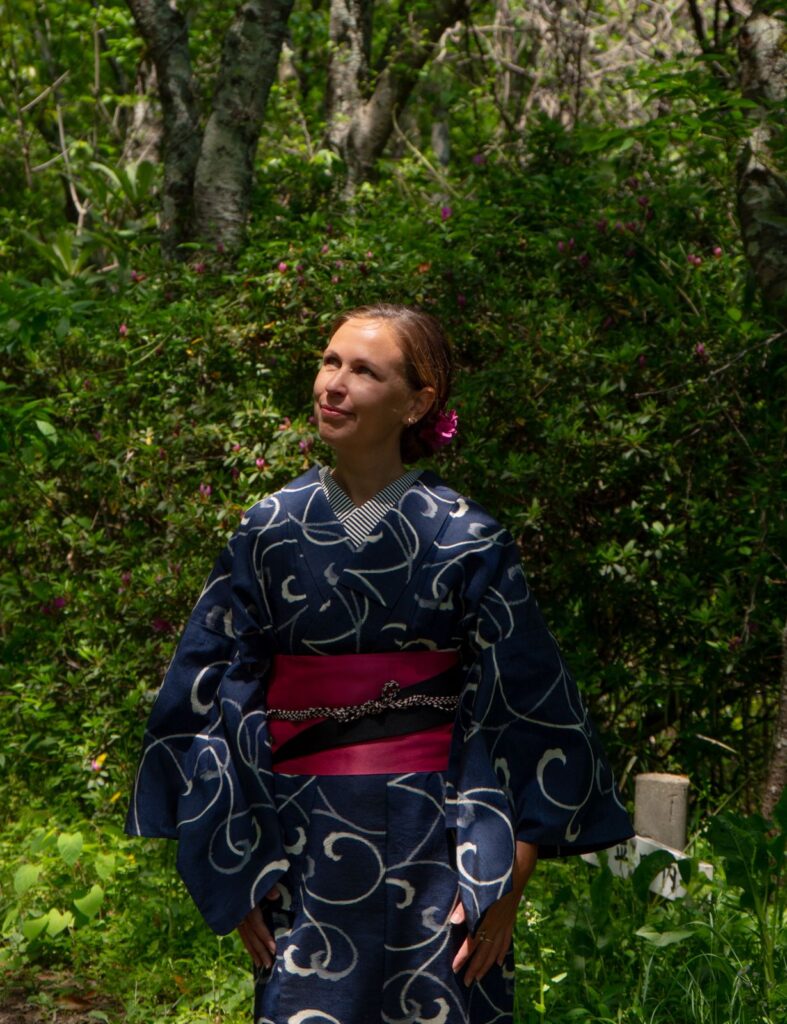
About the author
Manon, is a digital nomad and content creator. She lives between time zones, works between getaways, and shares the beauty of this joyful mess.